What’s happening?
Move over rugby and cricket, a fast and fiercely competitive school sport is gaining ground across Queensland.
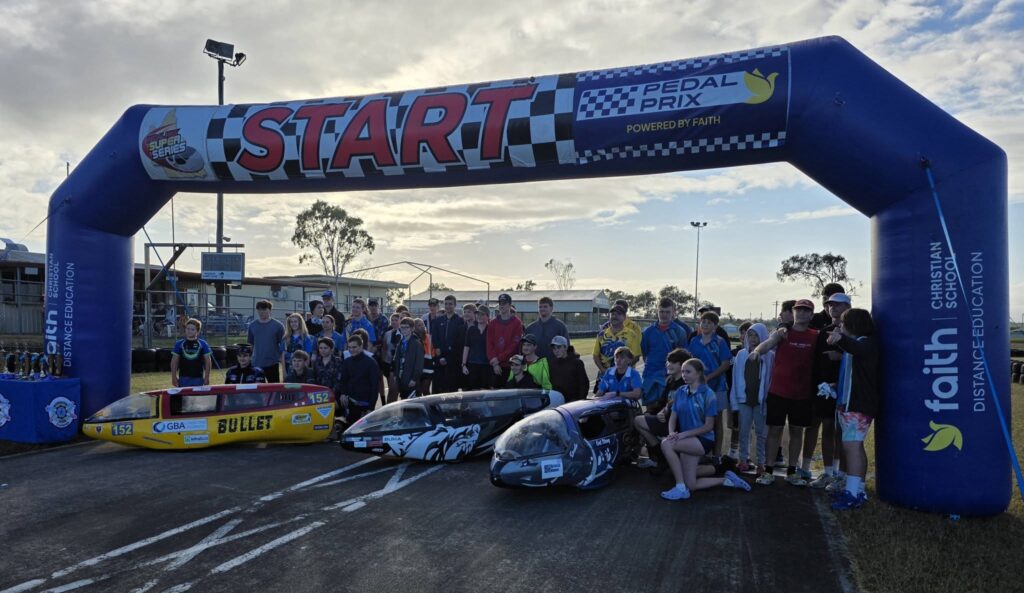
The Queensland Pedal Prix Super Series is giving students a very different kind of sporting challenge. Instead of simply turning up to play, teams design, build and race aerodynamic human-powered vehicles in endurance events that test fitness, strategy, engineering and teamwork.
Mackay became part of that growing story as local and visiting school teams came together for two days of racing. The event brought students, teachers and families into a high-energy setting where every decision mattered, from vehicle setup to driver changes and pit lane repairs.
Across Queensland, the series is showing how school sport can do more than reward athletic ability. It is helping students turn classroom learning into real track performance while building the confidence, discipline and practical skills needed beyond school.
Why it matters?
Pedal Prix matters because it gives students a hands-on way to connect sport with science, technology, engineering and mathematics.
To compete well, students need to understand how their vehicle moves, how small changes affect performance and how a team works under pressure. A gear change, tyre choice or aerodynamic adjustment can quickly show up in lap times, making physics feel immediate and useful.
The sport also teaches responsibility before students get behind the wheel of a car. On track, drivers must understand braking distances, speed differences, safe passing and awareness of other vehicles. Those lessons can support better road habits long before learner logbooks begin.
For schools, Pedal Prix offers a broader model of achievement. A student does not need to be the fastest runner or strongest player to have an important role. Drivers, mechanics, data analysts and logistics managers all shape the team’s result.
Local Impact
For Mackay, hosting a round of the Queensland Pedal Prix Super Series brought regional and visiting teams into the same competitive space.
The event gave local students a chance to test themselves against teams from across the state, while also showing how regional schools can stand strongly in a technical sport. In Pedal Prix, a clever build, a sharp pit crew and strong race planning can matter as much as money spent on equipment.
That makes the sport especially valuable for regional communities. Students with practical skills in fabrication, welding, repairs and problem-solving can bring those strengths directly into competition.
The Mackay round also created a shared community setting. Students, teachers and families worked side-by-side across two days, with teams helping each other through tools, parts and trackside support.
By the numbers
The Queensland Pedal Prix Super Series has grown into a major school competition, with reach across city and regional communities.
- More than 30 schools are involved in the series, including State schools, Catholic schools, independent Christian schools and distance-education colleges.
- More than 80 teams compete across different tracks and race conditions, giving students experience in sprint racing and longer endurance events.
- Mackay hosted two days of racing this month, with local and visiting teams converging for a regional round of the series.
Zoom In
The learning starts well before students reach the start line.
Teams design lightweight recumbent trikes and work on aerodynamic shapes to reduce drag. Some students experiment with carbon fibre and fibreglass canopies, while others focus on frame strength, gear ratios and tyre rolling resistance.
On race day, the pit lane becomes a working classroom. Students monitor live race data, plan driver stints, watch vehicle performance and make quick calls when something goes wrong.
A Southeast Queensland technology teacher said that is where the sport becomes powerful for students.
“It bridges the textbook gap perfectly,” the teacher said.
“When a student changes a sprocket and instantly sees their lap time drop by two seconds, physics becomes real. They are not just memorising formulas; they are living them.”
That mix of theory and action is one reason Pedal Prix continues to appeal to schools. Students see the link between effort, design and outcome in real time.
Zoom Out
The Queensland Pedal Prix Super Series now stretches across a range of tracks and settings, from Nerang Cycle Centre on the Gold Coast to regional hubs including Mackay and Emerald.
Its biggest stage is the round at Reid Park, the Townsville Supercars V8 street circuit. For students used to training on school grounds, racing on the same tarmac as professional motorsport drivers brings a very different level of pressure.
They must manage track position, vehicle control and passing etiquette while moving through a professional-style racing environment. It demands focus, patience and respect for other teams.
The format also helps reduce the gap between city and regional schools. A vehicle built in a regional State school can outperform an entry from a metropolitan private college if the design, teamwork and race strategy are stronger.
That is why Pedal Prix is becoming more than a school sport. It is also a pathway for young people interested in engineering, mechanics, data, logistics, sport and future leadership.
What To Look For Next?
Pedal Prix is likely to keep growing as Queensland schools look for activities that combine sport, practical learning and student wellbeing.
As more schools look for ways to build confident and technically skilled students, Pedal Prix offers a clear example of learning in motion. On three wheels, students are gaining skills they can carry into study, work and safer driving.