What’s Happening?
From artificial intelligence to everyday conversations, Macquarie Dictionary’s latest Word of the Year results reflect Australia’s changing language.
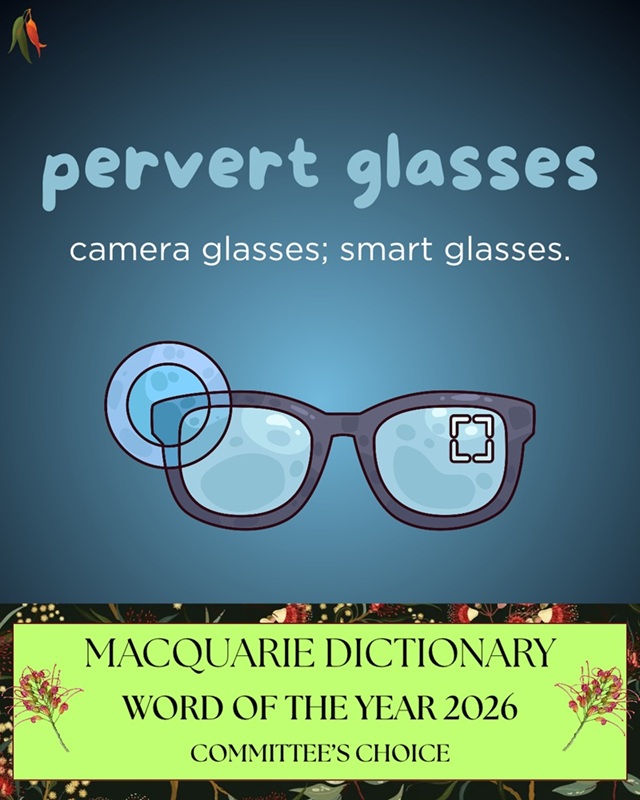
The dictionary announced pervert glasses as the winner of both its Committee’s Choice and People’s Choice awards on 24 November 2026. The expression refers to smart glasses or camera glasses, particularly in connection with secretly recording or photographing other people.
It emerged from the dictionary’s annual selection of newly recorded words and meanings.
Why It Matters
The result reflects a year when technology and privacy concerns have influenced the language people use to describe their experiences.
Rather than focusing only on the capabilities of smart glasses, the winning expression questions how those capabilities might affect others.
The committee considered the term especially relevant to discussions about artificial intelligence and increasing surveillance.
“The coinage pervert glasses is a succinct reflection of the state of the world in 2026 in so many ways. On the one hand, we’ve seen a massive acceleration in the capabilities of AI and products that integrate it. At the same time, the undeniably critical nickname mirrors the widespread calls to hit the brakes on this seemingly unchecked development. The name represents the year we’ve all endured, with AI, the manosphere, increasing surveillance in supermarkets, and more. Sure these new gadgets might be marketed as smart glasses or camera glasses, but it seems to us that pervert glasses paints a more apt reflection of the year.”
Local Impact
The public vote gave Australians a direct role in deciding which expression best captured the year’s cultural and social changes.
While the final choice centred on technology, the wider selection also recognised local experiences, medical terminology and digital habits. Together, the results offer an indication of the subjects influencing how Australians communicate.
By The Numbers
- 19 shortlisted terms: The entries reflected subjects including relationships, online behaviour, health, technology and local culture.
- 3 selections allowed: Participants in the People’s Choice competition could vote for their top three words.
- 3 consecutive agreements: The public and committee have reached the same Word of the Year decision for three years running.
Zoom In
Beyond the main winner, the committee’s honourable mentions demonstrated that significant language changes are not limited to technology. PMOS, or polyendocrine metabolic ovarian syndrome, was recognised as an updated medical term for the condition previously called PCOS.
The possibly genetic disorder can involve irregular ovulation and menstruation, acne, excess hair growth, insulin resistance and obesity. Its inclusion followed an Australian-led campaign to change terminology associated with the condition.
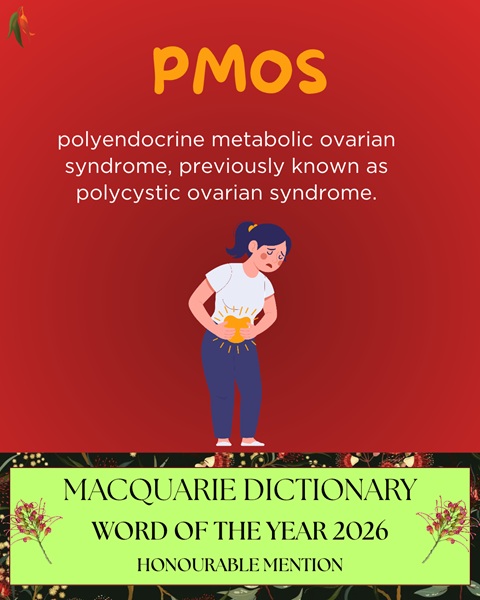
“As awareness of medical misogyny (a WOTY 2025 honourable mention) spreads, we hope to see more terms like PMOS entering the dictionary. It shows the power that language can hold, both negatively in the problems caused by the commonly misleading term PCOS, and positively in how this decade-long Australian-led campaign to rename this condition was recently adopted worldwide.”
The committee also selected agentic, a term increasingly used to describe artificial intelligence capable of acting or making decisions independently.
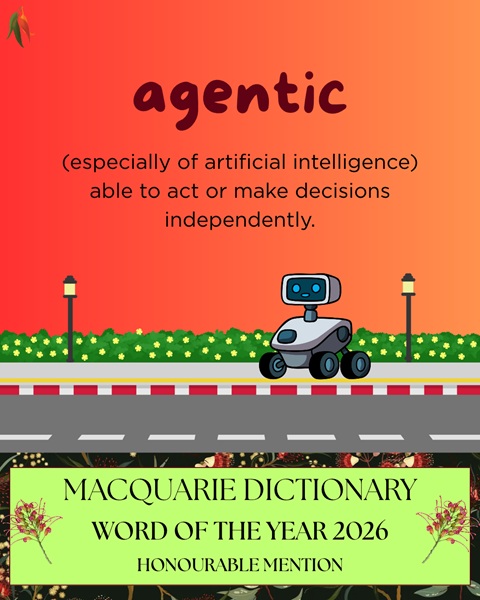
Its recognition reflects the growing discussion surrounding AI systems that can complete tasks without constant human instructions.
“While it might not be the most flashy, funny, or socially impactful word on the surface, agentic has seen an exponential increase in usage over the last 12 months. Where 2024 and 2025 saw the development and massive spread of large language models, the release of agentic AI tools such as OpenClaw and the mischief they recently wrought has brought this otherwise very technical term firmly into the mainstream.”
A different kind of expression appeared through Marrickville pause, named after the Sydney suburb located beneath an airport flight path.
It describes the brief interruption to conversations caused by passing aircraft, offering a distinctly local addition to Australian vocabulary.
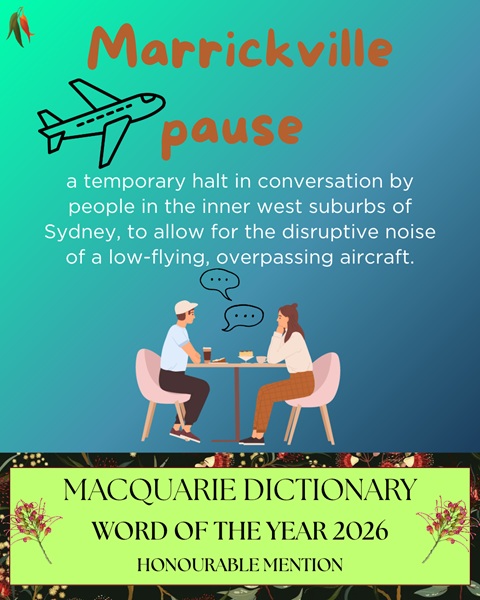
“It is undeniable that we are facing major cultural shifts in the digital world, and as a result, seeing huge language innovation at an international scale. Marrickville pause represents a departure from this trend – a highly localised term for a purely physical phenomenon, but one that is so universally experienced by people who spend time in the area.”
Zoom Out
The public’s honourable mentions revealed another common theme, with both expressions questioning the effects of digital technology.
Digital dementia refers to supposed cognitive difficulties associated with excessive reliance on devices, including memory and attention problems. The committee noted that the expression does not represent an established medical diagnosis.
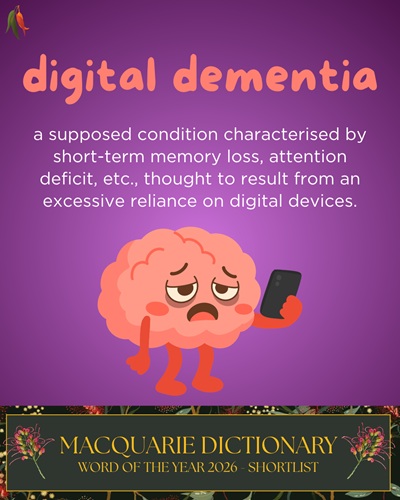
“Digital dementia is, of course, not a real medical diagnosis but that hasn’t stopped the fear of an increasing reliance on digital devices from resonating deeply. People are finding that they’re struggling to navigate without Google Maps and to make and remember plans without iCal. It will be interesting to see if all of this outsourcing does in fact lead to impaired cognition in the long term.”
Meanwhile, AI;DR describes a response used when someone considers AI-generated online content unworthy of reading. The expression follows the familiar TL;DR format and reflects frustration with the increasing volume of automated material.
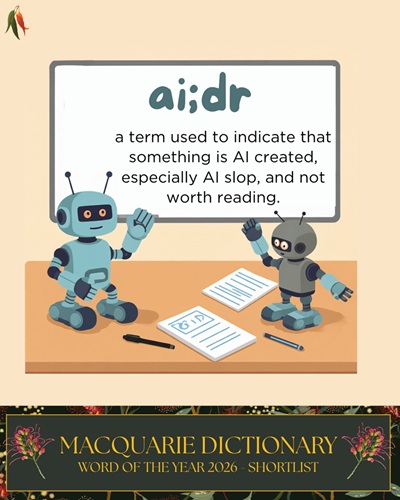
“A nice play on TL;DR (a code for too long; didn’t read), AI;DR gives fellow readers an instant heads-up that the text to follow is what they consider to be AI slop. As the sheer volume of AI generated text is ever-increasing, this succinct code will become a much-welcomed time saver.”
Other entries competing for recognition were analog bag, boy kibble, boysober, choppelganger, creaming, grwm, human-in-the-loop, limbs, nudify, safe phone, shark band, terramation and vertical drama.
Their inclusion demonstrates the range of new expressions entering the dictionary, from online trends to everyday experiences.
What To Look For Next?
The diversity of this year’s selections suggests Australian English will continue reflecting changes in technology, health and social behaviour. Although pervert glasses claimed the main awards, other shortlisted terms may continue gaining recognition through everyday use.
Macquarie Dictionary’s future selections could provide further insight into which expressions remain relevant as Australian language changes.